Specialists in the Automotive and Powersports markets

MAP Enforcement Trends: MAP Violations Surge 214%—Is Your Brand Protected?
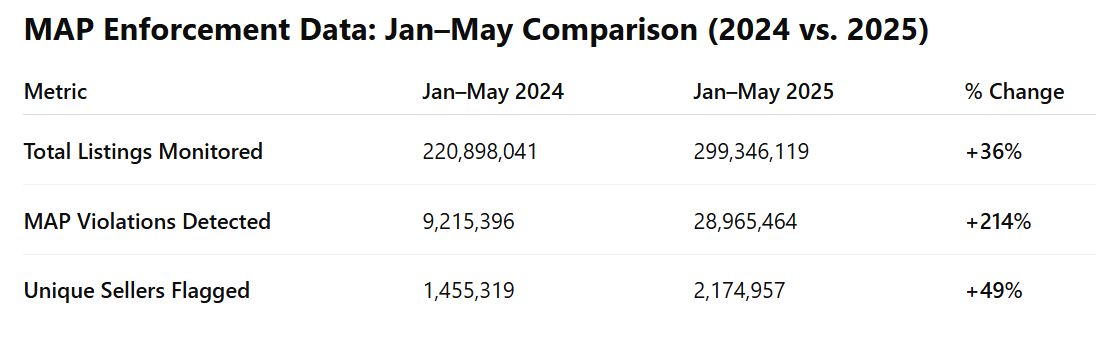
From January through May, our MAP enforcement systems have seen a striking increase in marketplace activity compared to the same period in 2024. Total listings monitored rose from 220.9 million in early 2024 to over 299.3 million in 2025—a 36% increase. This growth is fueled by the expansion of e-commerce channels, the onboarding of additional brands into our system, and enhanced scanning infrastructure that allows us to monitor more listings, more frequently, and across more platforms.
Most notably, detected MAP violations skyrocketed by 214%, from 9.2 million in Jan–May 2024 to nearly 29 million during the same months in 2025. This is not a sign of deteriorating compliance but rather a testament to the power and precision of our upgraded detection technology. Over the past year, we’ve deployed new AI-driven mechanisms to flag price violations—including bundled listing analysis, screenshot-based validation, and EPID (eBay Product ID) traceability—which have significantly expanded our enforcement net. More violations are being surfaced and acted upon in real time, giving our clients a measurable edge in brand protection.
Additionally, the number of unique sellers involved in MAP violations jumped 49%, from 1.45 million to 2.17 million. This reflects both the rise in online seller activity and the increasingly fragmented nature of the reseller ecosystem. Many violators operate multiple storefronts or attempt to obscure their identities across platforms. Our 2025 upgrades—particularly in cross-channel identity mapping and data enrichment—have enabled us to unmask and monitor these sellers more effectively than ever before. As the e-commerce landscape becomes more complex, our platform continues to evolve—giving brands the visibility and control they need to defend their value in every corner of the web.

Is Your Brand Ready for This Surge in MAP Violations?
At MAP Services Corp, we track what matters most to your brand—pricing integrity. And the numbers from January through May 2025 paint a clear picture: the threats are growing, but so is our ability to catch them.
What’s fueling this change?
• More brands joined our platform, expanding our monitoring reach
• Our powerful AI-powered detection tools now identify more complex violations like bundled listings, pairs and sets and image-based price manipulation
• We’ve improved seller tracking—catching those who operate across multiple stores under different names.
These improvements translate to real protection. You get more coverage, faster alerts, and actionable data on who’s violating your MAP policy and where.
Bottom line: The marketplace is more crowded and chaotic than ever. Our job is to give you clarity—and control.
If you haven’t seen what our latest enforcement platform can do, Now is the time to enlist MAP Services Corp to ensure your brand is not abused by unscrupulous sellers and pricing bots.
Give us a call or reach out today. We’re waiting to hear from you. 828-393-4076

Challenges in Enforcement and Brand Alignment
Beyond tracking violations, MAP enforcement this year has been challenged by several recurring roadblocks. Chief among them is inconsistent enforcement protocols, particularly when brands expand into international markets or partner with a diverse set of resellers and attempt to monitor and enforce on their own. Without a clearly unified enforcement structure, some brands struggle to take swift and meaningful action against violators—leading to erosion of pricing integrity. With MAP Services Corp notifies violators and ensures consistent follow-up until full compliance is achieved.
Another issue we’ve seen is reseller education gaps. Despite updated MAP policies and communication efforts, many retailers and distributors still cite confusion about MAP timelines, promotional exclusions, or the consequences of repeat offenses. This disconnect results in friction, not just with enforcement partners, but also within sales departments who often prioritize revenue over policy compliance.
Additionally, legal ambiguity surrounding MAP policies—especially in territories with strict price control regulations—continues to complicate enforcement for global brands. Some have begun to revise their policies to focus more on Unilateral Pricing Policies (UPPs) or Minimum Resale Price (MRP) frameworks to accommodate legal limitations while still preserving brand value. Give us a call and let us help you determine which is most effective for your brand.
Perhaps the most notable challenge is internal alignment. For many organizations, MAP enforcement sits at the crossroads of legal, sales, and marketing. When those departments aren’t fully coordinated, enforcement becomes fragmented and inconsistent. The most successful brands we’ve seen this year are the ones investing in internal cross-functional training, policy centralization, and real-time enforcement tools such as those provided by MAP Services Corp.

Strategic Insights for the Road Ahead
Looking forward, the second half of the year offers a prime opportunity for brands to reassess and recalibrate their MAP strategies. The key will be moving from reactive enforcement to proactive prevention, using data-driven insights and smarter automation.
First, brands should conduct a comprehensive policy audit—ensuring their MAP guidelines are clearly communicated, legally sound, and enforceable across all sales channels. This includes preparing for seasonal surges, back-to-school promotions, and Q4 holiday campaigns, where violations tend to spike.
Second, it’s time to double down on education. Communicating with resellers, providing real-world MAP scenarios, and maintaining transparent violation logs can help reinforce compliance and build goodwill. Our new client portal provides many ways to analyze data to easily identify trends and bad actors as well as sourcing legitimate, compliant resellers.
Lastly, brands should consider partnering with MAP Services Corp — Our platform combines real-time monitoring, AI-based anomaly detection, and automated violation workflows. These proprietary tools not only streamline enforcement but also provide analytics that help identify high-risk partners and pricing patterns.
By learning from the challenges and trends of the past six months, brands can fortify their MAP programs for the months ahead—protecting value, preserving margins, and strengthening retailer relationships in the process.